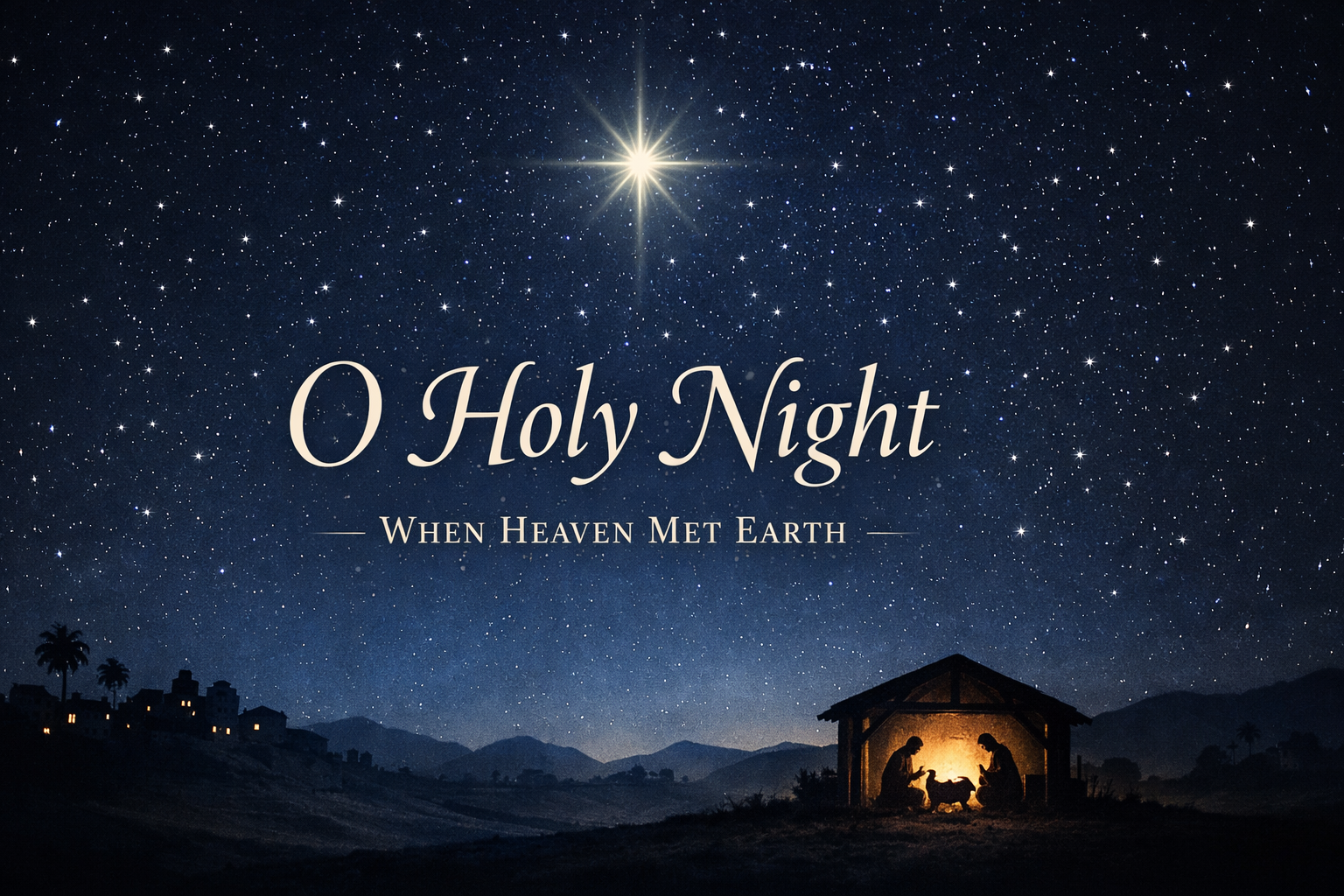
O Holy Night: When Heaven Met Earth in the Darkest Hour

There are Christmas carols we sing out of tradition—and then there are carols that stop us mid-breath. O Holy Night is one of those rare hymns. From its first line, it pulls us into a quiet, starlit moment when heaven broke into human history—not with fanfare, but with light piercing darkness.

So what makes O Holy Night linger in our hearts long after the last note fades?

A Night Marked by Darkness—and Hope

“Long lay the world in sin and error pining…”
The song doesn’t begin with celebration. It begins with waiting. With weariness. With a world aching for rescue. This is a reminder that Christmas was not born out of comfort, but out of desperation—a people longing for redemption they could not create on their own.

That truth resonates deeply with Christian readers and storytellers alike. We understand brokenness. We write about it. We live it. And this lyric reminds us that God chose that very moment—the lowest point—to step in.

“Till He Appeared and the Soul Felt Its Worth”

Few lines in any hymn carry such profound meaning. The coming of Christ didn’t just change history—it restored value to every soul. In a world that measures worth by status, success, or perfection, the manger declares something radical:

You matter because God came for you.

That message alone could carry an entire sermon—or an entire novel.

A Thrill of Hope

Not a shout. Not a trumpet blast.
A thrill.

Hope often arrives quietly—especially in our darkest nights. For weary hearts, discouraged believers, and those walking through grief or uncertainty, O Holy Night reminds us that hope doesn’t require everything to be fixed. It only requires God to be present.

And He is.

Fall on Your Knees

This isn’t a suggestion. It’s a response.

The proper reaction to the miracle of the Incarnation isn’t applause—it’s humility. Worship. Surrender. The song gently but firmly shifts our posture from observer to worshiper, from storyteller to witness.

Love That Breaks Chains

“Chains shall He break, for the slave is our brother…”

This is not only about physical chains, but spiritual ones—fear, shame, sin, despair. Christ didn’t come merely to comfort us; He came to set us free. That freedom is at the heart of the gospel and at the heart of every redemption story we love to read.

Why O Holy Night Still Matters

This carol endures because it tells the Christmas story honestly:

  • A broken world
  • A holy God
  • A humble entrance
  • A hope that changes everything

It reminds us that no night is too dark for God’s light to reach—and no soul is beyond His redeeming love.

As readers and writers of Christian stories, we recognize this truth:
The most powerful moments often begin in the shadows.

And that is why, year after year, we return to this song—standing beneath the stars, listening for angel voices, and remembering the night that changed the world forever.

Merry Christmas, Everyone!

Mary

Posted in Uncategorized | Leave a comment

The 365 Days of Christmas – Delores Topliff

It’s that time of year when we sing Christmas carols, and our hearts turn to the amazing eternal gift of God’s son sent to Bethlehem’s manger to redeem all who will receive and believe on His name.

This year, instead of singing the Twelve Days of Christmas, let’s expand it to include The 365 Days of Christmas (plus one more during Leap Year.)

Similarly, we look back over our year to thank Him for many things. We look forward like Moses and say, “”If Your Presence does not go with us, do not send us up from here,” Wonderfully if we ask Him, His presence does go with us! In fact, Hebrews 13:5, promises “I will never leave you nor forsake you.”

The truth is, instead of Him going with us, we seek to find His path and follow closely after Him. We had a need, and God sent His only son to be The Way Home to all who receive His gift to join His eternal family. This is the perfect time of year to remember that.

I love mission trips, taking the Good News to those who seldom hear it. Those trips have taken me to South America for 3.5 months in 1980, to Israel nine different times since 1984, and to the Philippines six times starting in 2007. Each time, we take funds, love, messages, and service, but we receive so much more in gratitude, life connections, and seeing precious lives changed forever.

2026 will soon be here. Ask the Lord what new thing He has tucked inside of it for you—how He may strengthen and use you in the coming year. As we partner with Him, resources are multiplied and limitations fall away. He works tirelessly and sends us forth with His words as instruments of His love. We are ambassadors representing the greatest authority anywhere to make Him known. Enjoy the process!

Winter and holidays are also a great time to read. Check my delorestopliff.com under the Books tab to find and choose my titles. You might especially enjoy The Christmas Tree Wars and The Traveling Grandma’s Guide to Israel: Adventures, Wit, and Wisdom – half memoir and half travelogue of nine lengthy trips to Israel over 41 years.

Posted in Uncategorized | Tagged , , , , | 1 Comment

Christmas Giving 2 by James R. Coggins

Historians are often very wise people. I know this because I am one. Historians are wise because they have access to far deeper reservoirs of experience. They learn from the centuries of experience of other people. As someone said, “Good decisions come from experience, and experience comes from bad decisions.”

One of the other historians I have come to know a little bit and appreciate a great deal is Gerry Bowler. Gerry has become a recognized expert on Christmas. He has written several books on the subject, including a biography of Santa Claus (actually, a history of the idea of Santa Claus).

One of the aspects of Christmas that I learned from reading Gerry’s work was the history of giving. From its beginning, the Christian church has encouraged and practiced giving to the poor and needy. However, things have changed in recent centuries:

• Originally, people in “Christian” countries gave gifts to the poor and needy.

• Then, as the world moved into the early modern era (after 1500 or so) society and priorities changed, and so did practices. Increasingly, wealthy people did not give to the poor and needy in general but to their own servants and employees, those in their own households. This practice still endures in many companies, which give their employees Christmas bonuses, Christmas turkeys, or Christmas banquets.

• In the 1800s, with the development of the idea of Santa Claus, there was a proliferation of children’s books and children’s toys. The focus of Christmas giving was still restricted to the household, but now the gifts were given to the parents’ own children, and not the servants and employees. This is still the central focus of much Christmas giving throughout the Western world.

• In very recent years, another shift has been taking place, with the emergence of Boxing Day sales. Now, a lot of the Christmas buying occurs after Christmas, as people go out to buy presents for themselves

The narrowing of Christmas giving is disturbing and haunting. The coming of Jesus at the first Christmas was “good news of great joy that will be for all the people” (Luke 2:10). But increasingly our focus has shifted from the whole world to our households, to our families, and finally to ourselves. This increasing selfishness is the opposite of what God intended when He sent the ultimate gift, His Son and our Savior, Jesus.

Posted in James R. Coggins | Tagged , , , , | Leave a comment

In the Midst of Advent by Tara Randel

We are in the midst of Advent. A time of anticipation. A celebration knowing that Jesus will soon come.

Imagine how Mary must have felt when we she found out she was greatly favored by God. That she would carry the Son of God.

Mary was greatly troubled at his words and wondered what kind of greeting this might be. But the angel said to her, “Do not be afraid, Mary; you have found favor with God. You will conceive and give birth to a son, and you are to call him Jesus. He will be great and will be called the Son of the Most High. The Lord God will give him the throne of his father David, and he will reign over Jacob’s descendants forever; his kingdom will never end.”

“How will this be,” Mary asked the angel, “since I am a virgin?”

The angel answered, “The Holy Spirit will come on you, and the power of the Most High will overshadow you. So the holy one to be born will be called the Son of God. Even Elizabeth your relative is going to have a child in her old age, and she who was said to be unable to conceive is in her sixth month. For no word from God will ever fail.”

“I am the Lord’s servant,” Mary answered. “May your word to me be fulfilled.” Then the angel left her.    Luke 1:29-38

May your word to me be fulfilled. Could you have said those words? Accept the future that Mary was about to step into?

Last week, my pastor had an evening for us to come together to read the Magnificat. It’s become a yearly tradition that we love; spending time with Mary’s beautiful response to the future.

In Luke 1:39-45, Mary visited her cousin Elizabeth, who was also pregnant with John the Baptist. He leapt in his mother’s womb when Mary announced that she would bear the Son of God. Because Mary was so moved by this, she gave praise.

And Mary said:

“My soul glorifies the Lord
and my spirit rejoices in God my Savior,
for he has been mindful
of the humble state of his servant.
From now on all generations will call me blessed,
for the Mighty One has done great things for me—
holy is his name.
His mercy extends to those who fear him,
from generation to generation.
He has performed mighty deeds with his arm;
he has scattered those who are proud in their inmost thoughts.
He has brought down rulers from their thrones
but has lifted up the humble.
He has filled the hungry with good things
but has sent the rich away empty.
He has helped his servant Israel,
remembering to be merciful
to Abraham and his descendants forever,
just as he promised our ancestors.”
Luke 1:46-55

This is the Magnificat. The prayer that Mary sang. She gave her all to the promise, even when her life was about to become more than she ever could have dreamed or prayed for. Her focus was on God the Father and how the coming of Jesus would change the world. I’m sure she was scared, but her praise and gratitude shone through in her words.

As we wait for Christmas, I pray that you will find time to be filled with that same anticipation. That we reflect on the coming of Jesus and His wonderful light.

I wish you and your family a Merry Christmas!

Posted in Tara Randel | Tagged , , , , , , , | 1 Comment

Christmas Giving by James R. Coggins

Recent visits to two widely different events have left me disturbed and thoughtful.

I was asked by our church to help serve dinner at a Christian street ministry. That evening, we served a simple but nutritious meal to about 150 clients. Most of the clients were street people, homeless. They were hungry—and grateful. But I soon realized that they needed far more than food. They also needed clean clothes, a warm, dry place to sleep, and access to clean water. Many had medical needs. Some were in wheelchairs, some were on crutches or had limps, some had badly curved spines, and some had gastro-intestinal problems and other ailments. Many were suffering from the effects of addiction and mental issues. All needed the hope and spiritual healing that Jesus brings. I served for one night, but I have great admiration for the regulars who serve meals at this ministry three times a day 365 days a year. They also provide a safe place to sleep, medical care, addiction recovery, counselling, long-term housing, and occupational training. The needs are enormous, but this ministry is meeting many of them.

The second visit was much different. My wife and I went to a Christmas craft fair, looking to buy some Christmas presents. For more than an hour, we walked up and down the many aisles in a massive event space. We inspected the wares in dozens and dozens of booths. As we walked away, I realized that we had not seen anything that anybody needed. Everything we had seen was a frivolous extra, a decoration, a novelty. The contrast between the two events was startling. When I considered the many needs of the clients at the street ministry, I realized that there was nothing in the vast Christmas market that they needed and very little that they could even use. And some items (such as the wine, alcohol, and “edible” products) would be detrimental.

Before these two events, my wife and I had already decided we would not buy each other presents this Christmas—not because we don’t love each other but because there was nothing we could think of that we needed or wanted. And we have asked other family members not to buy us anything either. We are old, and our wants and needs have diminished. When we look at our own Christmas shopping lists, we realize there are people on those lists who have considerable needs, which overshadow wants. I remember one year when we sent some Christmas money to some friends we knew were struggling. They later apologized for spending the money on a new toilet. This was something they needed, and we praised them for their wisdom.

Do not misunderstand. I recognize that there are times when frivolity, fun, games, and silliness are also a need. The manager at another street ministry told us that clients at its food bank gravitated first to the dessert section. Years ago, I wrote a major research paper on “Service and Pleasure in the Millennium: Ontario Baptist Attitudes to Amusements and Recreation between the World Wars.” Before this time, Baptists had stressed work and service, but during the Great Depression they realized that people (many of whom could not find work) also needed recreation (which they related to re-creation/divine renewal). Besides food and clothing, people also need hope, love, joy and peace.

But in our current time of economic dislocation, when many people are struggling, there is something wrong when needs are neglected and so many of our Christmas efforts are wasted on buying more useless gifts.

Posted in James R. Coggins | Tagged , , , , , , | Leave a comment

Jesus: The Promise Fulfilled

A Reflection on Prophecy, Hope, and the Faithfulness of God

One of the most beautiful threads woven throughout Scripture is this: God keeps His promises. From Genesis to Revelation, every chapter, every symbol, every whisper of hope points toward a Savior who would rescue the world from darkness.

And when Jesus stepped into Bethlehem’s humble night, prophecy didn’t just come true—it came alive.

Long Before the Manger

Hundreds of years before Jesus’ birth, the prophets were already telling His story:

  • Born of a virgin (Isaiah 7:14)
  • Born in Bethlehem (Micah 5:2)
  • A descendant of David (Jeremiah 23:5–6)
  • A light to those in darkness (Isaiah 9:2)
  • A suffering Savior who would bear our sins (Isaiah 53)

These were not vague predictions or poetic hopes. They were specific promises—clear signposts that pointed to the One who would come.

When Prophecy Stepped Into Our World

When Jesus was born, the impossible became reality. The Word became flesh. The Messiah foretold became the Messiah revealed. Every fulfilled prophecy reminds us that God’s timing is never late, His plan is never uncertain, and His love is always intentional.

The birth of Christ wasn’t an isolated miracle.
It was the culmination of centuries of divine preparation.

Why It Still Matters Today

Jesus fulfilling prophecy isn’t simply a theological fact—it’s a reminder for our hearts today.

  • God sees the end from the beginning.
  • He is faithful even when we are afraid.
  • He keeps every promise—even the ones we’re still waiting on.

When life feels uncertain, when the world seems dark, or when our prayers feel delayed, Christmas reminds us that God’s promises never fail. The same God who orchestrated the birth of Christ with perfect precision is working in your life with the same care.

A Promise You Can Hold On To

Every fulfilled prophecy invites us to trust Him more deeply.

The Savior who was promised…
The Savior who came…
The Savior who is coming again…

He is faithful.
He is present.
And He is for you.

So as we read the familiar story this season, may our hearts rekindle with awe. The Child in the manger wasn’t just a baby—He was the living proof that God always keeps His word.


Posted in Uncategorized | Leave a comment

Pausing to Listen by Nancy J. Farrier

One of the joy of living in Arizona, is the many beautiful sunrises and sunsets. The amazing array of colors and textures often make me stop and stare in awe and imagine the skies are God’s canvas, the sunset the picture He’s painting.

I recall one evening, as I drove home with my four daughters, the clouds caught the rays of the setting sun and changed from pinks and oranges to purples and blues. Three of my daughters and I were oohing and aahing as we watched the display. My fourth daughter glanced out the window and said, “I don’t see what’s so special.” We were shocked that she didn’t enjoy the sight as much as we did.

Thinking about that evening makes me also remember the story of the birth of a special baby in Bethlehem. I picture that city teeming with people who were there to be counted for the census. The inns were full. I’m sure people’s homes were filled to the brim with relatives. I imagine even the stables were overflowing with animals brought by the influx of travelers.

“And suddenly there was with the angel a multitude of the heavenly host praising God, and saying, Glory to God in the highest, and on earth peace, good will toward men.” Luke 2:13-14 KJV

You are probably very familiar with the story of the shepherds out in the hills with the sheep. A choir of angels appeared to them. An amazing sight. I wonder if the colors were blazing into the heavens, making the shepherds speechless with awe. What matters most is those shepherds heard the message and sought out the baby, Jesus.

Meanwhile, what about the people in the city? The teeming crowds? The overflowing inns? This is a question I ponder every year. They were even closer to the Christ child. Did they forget to seek God and thus missed one of the most important message of all time? I picture the song of the angels rippling through the air, there for anyone to hear, if they’d taken the time to listen. I picture the skies lit up with the glory of God as praises were sung to Him. 

Were the women in Bethlehem too busy cooking, cleaning, making sure everyone had a place to sleep? Were they visiting with people they hadn’t seen in ages? Sharing recipes? Talking about their children?

Were the men busy caring for animals, talking about planting or raising herds? Were they discussing the government and how difficult the trip had been? Were they back-slapping and greeting one another? Maybe arguing or talking about other tribes.

What were they all doing that they missed seeing the glory of the message of Christ’s birth? Perhaps, they did see, but for whatever reason, chose to say, “I don’t see what’s so special.” 

Each Christmas I am threatened with all the hubbub of shopping, candy making, parties, decorating, visiting, and on the list goes. Every year there seems to be one more thing added to my to do items. If I’m not careful it’s easy for me to lose focus and to forget to acknowledge the One the season is celebrating. I am in danger of keeping my eyes fixed on all that is around me, pulling me to get this or that done. 

Like those shepherds of old, I want to hear that singing and to gaze up—to see the wonder and glory of a God who loves me beyond understanding. To see a Savior who gave His life for me. To bask in a reminder of beauty beyond anything I’ve ever experienced before.

I hope you will take a moment to “listen and look up” this Christmas season. Enjoy the love that is pouring out of Heaven. Enjoy God’s gift to us all.

“For unto us a child is born, unto us a son is given…” Is. 9:6 KJV

Posted in Nancy J. Farrier | Tagged , , , | Leave a comment

An Ordinary Christian Speaking to Other Ordinary Christians by James R. Coggins

My mother was a godly woman. It was no accident. My parents got up early, and my father worked hard for long hours, so my mother would prepare a large breakfast for him. When he had gone to work, Mom would sit down at the kitchen table with a second cup of coffee and “prepare her Sunday school lesson.” She had about an hour before it was time to wake the three children for school. That in-depth study of the Bible changed her life.

For decades, my mother taught Sunday school in the small Baptist church in our small town. She began with elementary school children, and in her later years she taught adult Sunday school. I knew she often went to “mission circle” when I and the other children were at school. What I did not know was that she was a frequent speaker at these meetings and even in regional meetings of mission circles from other Baptist churches. She was humble and not one to publicize her achievements. But her role should not have been a surprise to me. She was a homemaker, but being a homemaker in those days meant that she did laundry with a wringer washing machine and clothesline, baked her own pies and cakes, and sewed clothes and canned food for her family. It was a demanding occupation rarely recognized today. I knew that Mom also found time to maintain strong relationships with friends, neighbors, and family members. And she maintained an extensive correspondence with distant missionaries, friends, and relatives. Unusual for her time, she had not only graduated from high school but also attended both teacher’s college and business college. She had worked as a teacher and an office worker before marrying my father in 1946.

My mother did not just read the Bible. She studied it. According to her notes, she also read many of the key Christian books of her time, some that she owned and many that she borrowed from the church library. She also read letters and reports from missionaries, and a variety of Christian and other magazines.

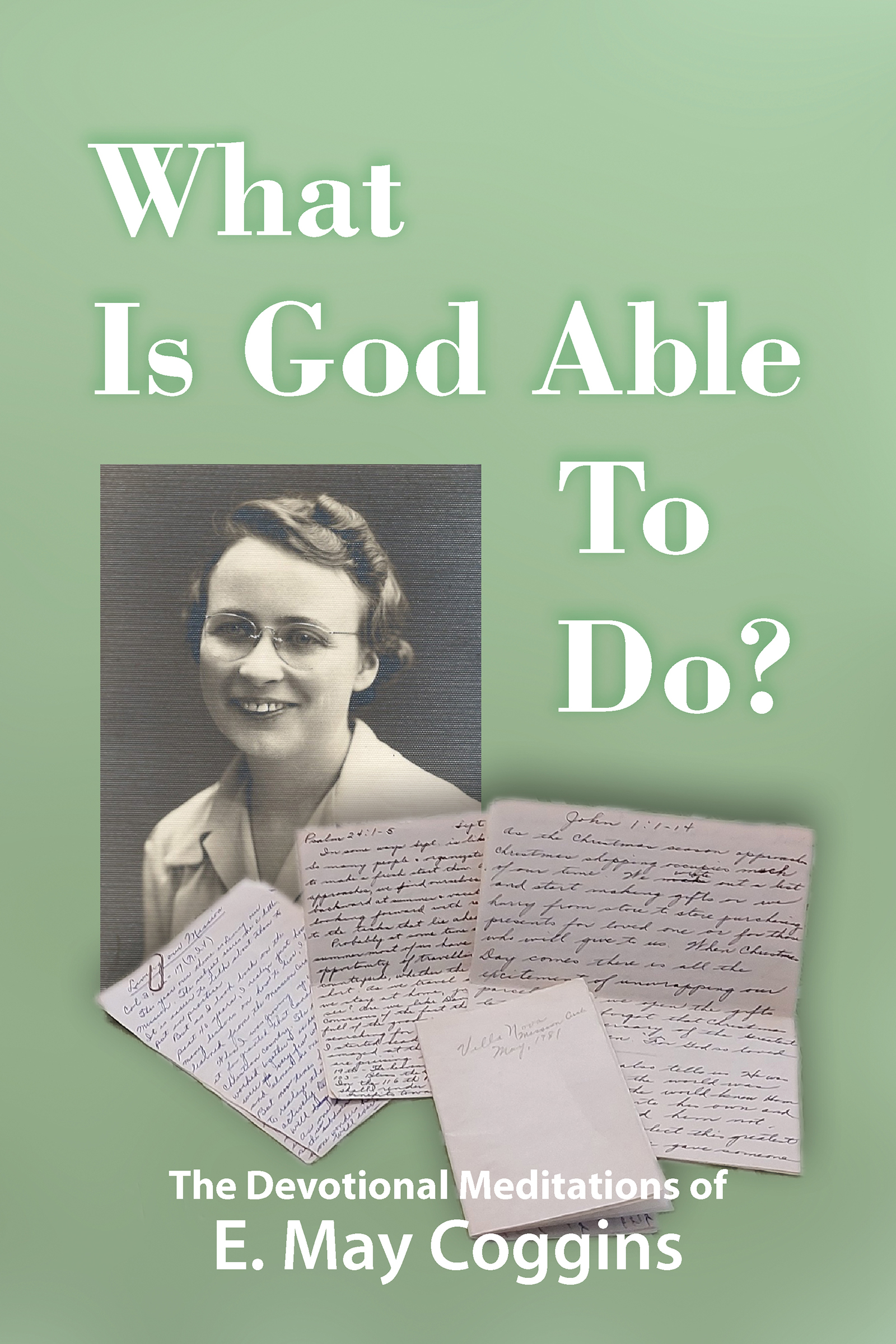
Mom was also somewhat of a packrat. After she died, we found among her possessions many of the “meditations” she had prepared for mission circle meetings and other occasions. I read them first as part of my own daily devotions. Then, I decided to collect and publish them in a book. The book, What Is God Able to Do? The Devotional Meditations of E. May Coggins, has now been published. It contains my mother’s meditations, presented mostly as they appeared in her notes, with occasionally a few words added to fill in the gaps.

Why do we pray? What is God able to do? Why is the Bible like a valentine? Is God alive? Can you sign up for immortality? What causes worry? What are you searching for? What do we see? What do you have in the house? Why hobbies? Do we sometimes get into a rut at Christmas? These are just some of the practical spiritual questions my mother addressed in this collection of biblical meditations. This volume offers insight into life, particularly Christian and church life, in a previous century. It might perhaps be considered an historical source document, maybe even an historical curiosity or a relic of a bygone era. For sure, my mother had a view of life that would be unusual today. Among the foundational beliefs flowing through these meditations are these insights:

            • Life is hard.

            • Faith is hard.

            • We are here on this earth to serve.

            • We can find God in everyday things and activities and in ordinary people.

It is true that these ideas now seem quaint and old-fashioned. But that is their power and importance. The meditations offer a corrective to our own modern biases. They contain wisdom and insights from a previous generation that can help us today, and in that sense they are as relevant today as they were in the last century, perhaps even more relevant.

History often focuses on the thoughts and acts of the great and powerful, while the life of ordinary people is forgotten. My mother was just an ordinary Christian speaking to other ordinary Christians in her small town church. And yet an ordinary Christian, a believer in an extraordinary God, can have a significant impact, perhaps an even greater impact simply because she is ordinary. Jesus’ first disciples were all ordinary men who had been with Jesus (Acts 4:13). Gandalf, in J.R.R. Tolkien’s masterful trilogy The Lord of the Rings, said: “Saruman believes it is only great power that can hold evil in check, but that is not what I have found. I’ve found it is the small, everyday deeds of ordinary folk that keep the darkness at bay. Simple acts of kindness and love.” That is what this volume is all about—the thoughts of an ordinary woman, believing in an extraordinary God, encouraging other ordinary people to believe in the light and to devote themselves to simple acts of kindness and love.

Posted in James R. Coggins | Tagged , , , , , , , | Leave a comment

Antiochus Epiphanes by James R. Coggins

The Jews were dragged into exile in Babylon by the armies of the Babylonian empire about 587 BC. When the Babylonian empire was overthrown by the Persian empire about 539 BC, the Persians encouraged the Jews to return to the Promised Land. The Persian empire, in turn, was overthrown by Alexander the Great and his Greek armies. After he died, his empire was eventually divided among four of his generals, including the “Kingdom of the North” (ruled by the Seleucids, based in Syria, to the north of Judah) and the “Kingdom of the South” (ruled by the Ptolemies, based in Egypt, to the southwest of Judah). These remnants of Alexander’s empire tried to impose Greek culture and religion on the lands they controlled. Several of the Seleucid kings were named Antiochus, including Antiochus IV, who ruled about 175-163 BC and gave himself the title Epiphanes, which means “God manifest.” Like many dictators, he claimed divine power and demanded to be worshiped. In the early years of the Persian empire, Daniel was given a prophecy about the political future of the Middle East. The prophecy described in accurate detail the incessant wars between the King of the North and the King of the South, with the Jewish people living between these two brutal kingdoms and suffering through many invasions. Daniel 11:21-32 outlines the reign of Antiochus Epiphanes, describing him as a “contemptible person,” cruel and deceitful, who went about invading and pillaging other countries. Daniel prophesied: “His armed forces will rise up to desecrate the temple fortress and will abolish the daily sacrifice. Then they will set up the abomination that causes desolation” (Daniel 11:31). About 167 BC, Antiochus entered the temple in Jerusalem and erected an altar to the Greek god Jupiter (which Daniel called “the abomination that causes desolation”). This spurred the Jews to rebel and regain their independence for a time. Antiochus was a nasty dictator, one of many nasty dictators throughout the history of the world and a model of Antichristian rulers.

Sixteen cities were named “Antioch” after the kings named Antiochus, including Antioch in northern Syria, which, in the time of Jesus, was one of the largest cities in the Roman empire. (Another was Antioch in Pisidia in the central part of what is now Turkey: Acts 13:14). Antioch in Syria was a center of Greek culture. It was also the home of one of the first predominantly gentile churches and the place where believers in Jesus were first called Christians (Acts 11:19-26). And it was the church which sent out Paul, Barnabas, Silas, and Timothy (Acts 13:1-3), launching the missionary movement which evangelized the Roman empire and eventually many other parts of the world. In this way, God quietly goes about bringing good, even from the most evil of places.

Posted in James R. Coggins | Tagged , , , , , , , , , , | Leave a comment

Books Must be Written in Solitude by James R. Coggins

Books—that is, creative books and fiction—cannot be written by a committee. They spring from one person’s unified vision. Adding a second or third writer only creates confusion.

This does not mean that a writer can produce a book without all kinds of help—technical experts, proofreaders, designers, marketers, ghost writers in some cases, and editors (after all, I are one of those). But the writing should be done by one person.

I am aware, of course, that some books have been written collaboratively, almost always by two people (not more) who are closely connected or even related. But those are the exceptions, and such collaborators usually produce genre books following a certain formula.

Because of the need for a unified vision, writers require solitude. They need to be able to get away from distractions and have time alone to think and write. They need to get somewhere where they can fully concentrate as they feverishly try to record their ideas and insights while they are fresh. That place can be an office or a secluded spot in nature or even the back corner of a coffee shop. It doesn’t matter as long as the writer is alone.

Because of this, writers are often thought to be anti-social introverts. This is true—to a point.

But writers need more than solitude.

I think it was Scott Young, a sports journalist, who decided it was time to write a book. He went away to a cabin in the wilderness where he could fully devote himself to writing. He soon discovered that it didn’t work. Sitting there alone staring at four walls, he couldn’t write.

Besides solitude, writers also need inspiration. And inspiration depends on experiences, observation, and stimulation. Writer Max Braithwaite pointed out that a writer is not primarily someone who writes but someone who observes. A writer will look at the surrounding life and ponder what people look like, how people act, why they act that way, what they think, what they might have done instead, etc. In other words, a writer also needs to be involved in life. As an editor once advised me when I was starting out as a writer, “If you want to be a great writer, live deeply.”

Writers need solitude, but they also need to be connected to life.

Posted in James R. Coggins | Tagged , , , , , , , , , , | Leave a comment

A Heart of Gratitude: Reflections for Thanksgiving

As we gather around our tables this Thanksgiving—whether in a bustling house filled with family, or in the quiet peace of home—it’s a beautiful opportunity to pause and remember the goodness of God.

Thanksgiving isn’t just a holiday; it’s a posture of the heart. It’s that sacred moment when we look back over the past year and recognize the fingerprints of God in the ordinary and extraordinary places of our lives.

Gratitude in Every Season

Some years, gratitude flows easily—laughter echoing through the house, blessings abundant, prayers answered. Other years, Thanksgiving comes with a softer step… through loss, waiting, unanswered questions, or trials that have stretched us thin.

And yet, Scripture reminds us gently:

“In every thing give thanks: for this is the will of God in Christ Jesus concerning you.”
—1 Thessalonians 5:18 (KJV)

Giving thanks in all things doesn’t mean all things are easy. It means God is present in every moment—steady, faithful, unchanging.

The Table of Remembrance

Thanksgiving is our modern-day Ebenezer—our reminder that
“Hitherto hath the LORD helped us.” (1 Samuel 7:12)

So as we gather…

To pass the turkey
To share memories
To watch little hands sneak rolls from the basket
To laugh, to pray, to simply be together

…we are doing more than celebrating a holiday. We are remembering God’s provision.

Thankfulness as Worship

When we thank God, we’re not just listing blessings.
We are acknowledging the Giver.

We are declaring that even in the unknowns, He is worthy.
Even when we don’t see the whole story, He is good.
Even when our hearts ache, He is near.

“Enter into his gates with thanksgiving, and into his courts with praise.”
—Psalm 100:4

Happy Thanksgiving, dear friends.
May gratitude be the melody that carries you through every season ahead.

Mary

Posted in Uncategorized | Leave a comment

Hidden Treasures by Tara Randel

Recently, my mother sold her house. She’d lived there for almost fifty years. It was bittersweet to say goodbye, especially after going through the house to decide what she should keep and what to give away.

My mom and I spent hours going through each room. There were lots of stories that went along with Christmas decorations, certain pieces of furniture, and pictures. Lots of pictures! I got to take a box home to go through when I get some free time. I’m sure I’ll laugh and maybe shed a tear or two when I do.

There were a lot of pieces I didn’t recognize from when I lived at home. One in particular caught my attention. Can you guess what it is?

It’s a portable lap writing desk. I’ve only read about them in the historical novels I love to read. Who knew we had one?

I don’t believe it’s an antique. My mom thinks my brother made it, but I haven’t gotten confirmation on that. I don’t care if it’s antique or not, I think it’s cool and asked if I could have it. My mom said yes, and that I should also take her writing desk. For an author, it doesn’t get any better than this!

It’s funny how things change in life. I never expected to receive these treasures. My mom was thrilled to give them to me, and I hope to pass them on when the time is right.

And speaking of family, I wish you and yours a very Happy Thanksgiving. Enjoy the turkey and sides, pumpkin pie, the parade and football games! Whatever your family traditions are, make sure you’re together. I’m sure some treasures will be revealed in the time spent with your loved ones.

Tara Randel is an award-winning, USA Today bestselling author. Family values, a bit of mystery and of course, love and romance, are her favorite themes, because she believes love is the greatest gift of all. Look for her Harlequin Heartwarming romance THE SURPRISE NEXT DOOR, available now. For more information about her books, visit Tara at www.tararandel.com. Like her on Facebook at http://www.facebook.com/TaraRandelBooks

Posted in Tara Randel | Tagged , , , , , , | Leave a comment

And Now for Something Different by James R. Coggins

NEW BOOK! NEW BOOK!

I have never been a conventional writer. My mind flies all over the place. I am sometimes known as a writer of murder mysteries. I have written four of them (Who’s Grace?, Desolation Highway, Mountaintop Drive, and Springtime in Winnipeg). I have also published a collection of three novellas (short novels) in the same genre (Too Many Deaths). But that is not all. I have written and had published a PhD thesis in History (John Smyth’s Congregation: English Separatism, Mennonite Influence, and the Elect Nation). And I have written a socio-political novel (1995: Je me souviens) and a popular-level reflection on the Bible book of Daniel (Living for God in a Pagan Society: What Daniel Can Teach Us).

And now something new and different. My new book, hot off the press in time for Christmas, is The Cabin and other stories.

My murder mysteries were deliberately written for a general audience, with only a subtle Christian message. Some of the main characters are Christians, and some are not. The idea is that for a non-Christian reader it would be like living next door to a Christian and trying to figure out what makes him tick.

My new book is quite different, being written primarily for Christians, although others might well benefit from it. It is a collection of stories, some long, some short, many recognizably ordinary, some fanciful or allegorical. They are set in a wide variety of times and places, most in the present but some in ancient times, most in North America but some in other places. They explore a wide variety of themes, human, biblical, and theological. At their heart are people, young Victor and old John, young couples and loners, simple folk and a few odd university professors. If there is a common theme, it is that all of these people, in various times and places, are surprised by grace. The title story, “The Cabin,” is centered on John, an old man who shows up in church one morning and who seemingly lives a simple life in a log cabin; however, there is much more going on under the surface. The final story, “Dead Man,” is a John Smyth murder mystery but with a much clearer Christian message.

I wrote the first of these stories in my 30s, but several of the stories, including the longest two, were written in my 70s. I am convinced that they are some of the best things I have ever written. It is my hope that some of them will endure, that they will be worth reading more than once, that they will not only stir the emotions but also stimulate the mind, that they will disrupt and disturb sinful complacency, that they will lead the reader to ponder, wonder, and understand.

The book is available in the usual places, through bookstores and through online retailers such as Amazon.

Posted in James R. Coggins | Tagged , , , , , , | Leave a comment

Something to rest on …


Mahalia Jackson, the “Queen of Gospel,”was orphaned in early childhood and raised by an aunt. They lived next door to a church in New Orleans where she first heard gospel music. She also heard blues singers but remained a devoted Baptist who only sang gospel,

Born in 1911, she brought gospel music to mainstream, secular audiences. She reached national prominence in 1947 with the release of “Move On Up a Little Higher,” selling two million records and reaching number one status on sales charts, a first for gospel music.  

In 1939, when segregation barred her from singing in Constitution Hall, first lady Eleonor Roosevelt arranged for Jackson to sing outdoors at the Lincoln Memorial to a far larger audience than would have fit inside any concert hall. She fulfills Proverbs 18:16, “a man’s (or woman’s) gift makes room for him (or her).” It’s also a demonstration of someone overcoming prejudice and hardships to win a vast audience and lasting victory.  

Jackson’s songs conveyed her faith. She said, “When you sing gospel you have a feeling there is a cure for what’s wrong. But when you are through with the blues, you’ve got nothing to rest on.” She established a path that encourages and edifies us all. Take time to find any of her songs online and be blessed today.

Posted in Uncategorized | Tagged , , , , | Leave a comment

Praise at the Dedication of the Temple by James R. Coggins

Psalm 30 is described as “a song of David for the dedication of the temple .” It can be understood as both a personal testimonial by King David and as a corporate expression of faith for the people of God.

It should be remembered that David was not allowed to build the temple because of his violence and sinfulness. But he was allowed to prepare for it, both in procuring materials and apparently also in helping to prepare a liturgy, including composing this psalm.

The psalm assumes a somewhat complicated history and relationship between David and God, something most of us can identify with. Sometimes things go well for us, and sometimes they don’t. We might be tempted to question God about this. But then we should remember that sometimes we do well and are faithful to God, and sometimes we fail. We should be wary about getting into an argument with God about which of us is more faithful.

First, David praises God for answering his prayers and rescuing him from death: “I will exalt you, Lord, for you lifted me out of the depths and did not let my enemies gloat over me. Lord my God, I called to you for help, and you healed me. You, Lord, brought me up from the realm of the dead; you spared me from going down to the pit” (Psalm 30:1-3 NIV). Besides his wars against the Philistines and other enemies, David had been rescued from death when hunted by Saul and when threatened by Absolom’s rebellion.

There were also times when David felt “secure” and God “made my royal mountain stand firm” (verses 6-7). The mountain, of course, is Zion, the location of Jerusalem, which David conquered and made his capital and which was the future site for God’s temple. Jerusalem is called “the city of David.” David saw these good time blessings as also coming from God and praised Him.

But then God hid His face and David felt “dismayed” (verse 7). This might have been when David sinned (with Bathsheba and when taking a census of his fighting men, for example). God was not being fickle. It was David who had proved unfaithful, and God rightly withdrew His approval. The good news is that God’s mercy is greater than His judgement—”his anger lasts only a moment, but his favor lasts a lifetime” (verse 5), and so once again David pleaded for forgiveness, mercy, and help. Again, God restored David, and David responded again with praise, praise of God’s justice as well as His mercy.

What was true of David was true of Israel. Israel’s history is one of answered prayer, blessing, sin, repentance, and redemption. And so is ours. For this reason, we also should praise God.

Posted in James R. Coggins | Tagged , , , , , , , | Leave a comment